
History of Reykjanes Harbour
Njarðvík Harbour
The history of Njarðvík Harbour dates back to the early part of the 20th century, when fisheries began to develop into one of the main pillars of Icelandic economic life.
Before harbour structures were built, fishing boats were operated by being pushed out to sea in the morning and pulled back ashore at the end of the day using manual labour alone, in Njarðvík as in other coves around the country. There was no need for piers or harbour facilities during the era of rowing boats, but this changed with the mechanisation of the fishing fleet, as the boats became larger and heavier. The people in Njarðvík acquired their first motorboat around 1911, and it is believed to have been the eight-oared boat Ársæll, which Magnús Ólafsson of Höskuldarkot equipped with an engine.
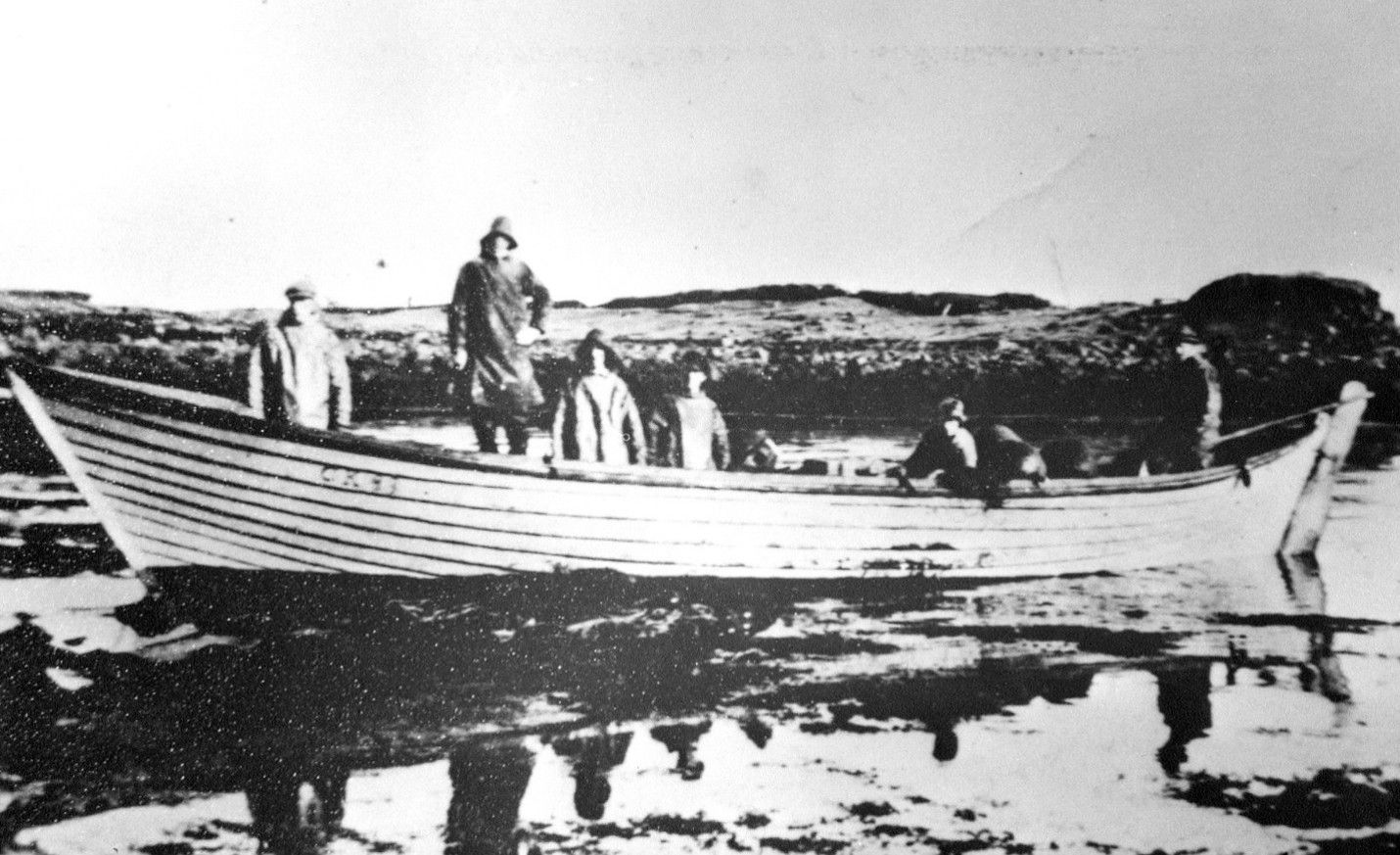
A rowing boat from the early days of rowing-boat fisheries. Photograph from the Reykjanesbær Heritage Museum, photographer unknown.
In the early decades of the 20th century, harbour construction was largely in the hands of private individuals; fishing vessel owners financed and carried out the construction of the piers they required themselves. These were, at most, short pier structures intended for smaller boats and were also exposed to the open sea, making them unreliable in rough weather. Mention should be made of Magnús Ólafsson’s pier at Höskuldarkot, as it later played a role in the development of the harbour in Njarðvík and forms the foundation of the present Norðurgarður (North Breakwater). Also noteworthy is Karvelsbryggja, or Frystihúsabryggja (Freezing Plant Pier), which was built at the initiative of Karvel Ögmundsson and forms the foundation of the present Suðurgarður (South Breakwater).
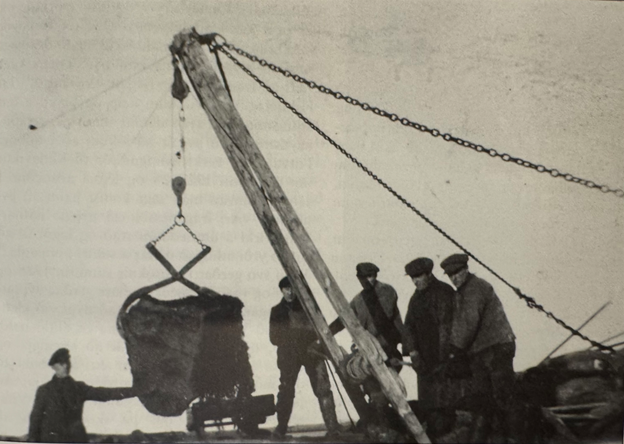
From the pier construction in Ytri-Njarðvík under the direction of fishing entrepreneur Magnús Ólafsson of Höskuldarkot. Photograph from the book Saga Njarðvíkur.
Calls for Improvements in Harbour Matters
Fishing vessel owners operating from Keflavík had obtained access, for a fee, to a private pier belonging to Hans Peter Duus, who was a fishing vessel owner and ran the Duus trading company in Keflavík, where the Duus Museum buildings are now located. Residents demanded improvements in harbour conditions, and in 1912 a public meeting was held in Keflavík municipality at which harbour issues were the main item on the agenda. At this time, people across the country were also becoming aware of the need to improve harbour facilities nationwide, and a year later the state commissioned a survey of pier conditions.
In 1915, Alþingi decided to employ a qualified professional to travel around the country and evaluate where suitable harbours could be developed. The person chosen was a Danish engineer by the name of N.P. Kirk, who had been working as chief engineer of harbour construction in Reykjavík since 1913. When it came to Njarðvík, Kirk’s evaluation was that the cove was one of three locations on the Reykjanes Peninsula where it would be suitable to establish a fishing harbour. However, Njarðvík was exposed to weather and winds from the east and the north, and Kirk’s proposals therefore involved largely enclosing the cove with protective breakwaters extending from Klapparnef on the outer side and Hákotstangar on the inner side. In this way, it would be possible to construct a pier between the breakwaters.
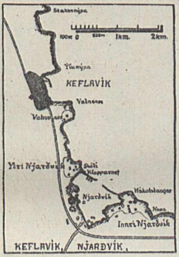
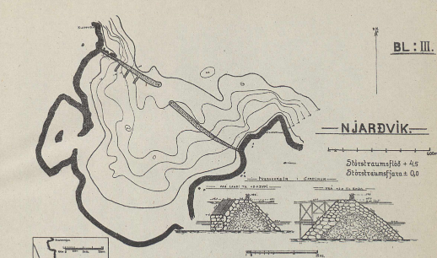
Kirk’s proposals for the development of a harbour in Njarðvík. The engineer Thorvald Krabbe later set Kirk’s ideas down in report form after Kirk’s death. Images from Tímarit Verkfræðingafélags Íslands.
Parish Rivalry
When work began on surveying and developing harbour infrastructure, the municipalities of Keflavík and Njarðvík had already been merged. This union took place in 1908 and lasted until 1942, when the municipalities were separated again, partly due to disagreements over harbour matters. Discussion about whether to develop a harbour in Njarðvík or Keflavík therefore became a contentious issue, and many residents of Keflavík considered it unacceptable to build in Njarðvík, even though an engineer’s assessment supported it.
Both the Ministry of Labour and Transportation and the Lighthouse and Harbour Authority were involved in the matter, and Njarðvík was consistently regarded as the better option compared with developing harbour facilities at Vatnsnes, which was among the sites considered in Keflavík. Fishing vessel owners in Keflavík municipality, however, had their sights set on Keflavíkurgróf.
To make a long story short, when it came to the outcome of the first harbour in the combined municipality of Keflavík and Njarðvík, the result was that the fishing entrepreneur Óskar Halldórsson negotiated with the landowner at Vatnsnes for rights to construct a pier and obtained access to the existing data from earlier studies on the feasibility of building harbour facilities there. The construction of the pier was completed in 1933, but it was not useful for motorboats.
Development Begins at Njarðvík Harbour
Around 1940, discussions began in earnest about the development of a large harbour in Njarðvík. The plans involved building a 160-metre-long breakwater extending from Klapparnef and a harbour wall approximately 400 metres long, constructed of stone and concrete, to the southeast of Klapparnef. The depth alongside the harbour wall would be five to eight metres. Inside Klapparnef and extending toward the pier owned by Magnús Ólafsson at Höskuldarkot, a land reclamation area of 3,500 square metres was planned.
At about the same time, the state began examining the possibility of constructing a secure harbour on the southern side of Faxaflói Bay, and attention turned to developing a harbour at Ytri-Njarðvík. The location was considered promising, as it would be possible to enclose the bay with two breakwaters on either side and the construction of a protective barrier. Poor harbour conditions along the southern and western shores of Faxaflói were considered a hindrance to fishing in the bay.
In 1942, a committee was appointed in Alþingi to propose measures to strengthen the position of the fishing industry in the country. In the report accompanying a parliamentary resolution from that year, it is stated that the renewal of the fishing fleet would be one of the major tasks in the coming years, as there had been little renewal of fishing vessels in the years before the war. The condition of the fishing industry improved during the war years, however, and it was considered urgent to improve facilities at those fishing stations most frequently used by incoming boats.
At that time, it was common for boats to be operated from places other than their home port for part of the year. The fisheries committee therefore proposed that so‑called national harbours be established at suitable fishing locations around the country. When the committee concluded its work in 1945, it had only examined the possibility of building such a harbour at Njarðvík. As before, these ideas were a source of irritation to fishing operators in Keflavík, who pointed instead to the development at Vatnsnes. The municipal councils of Njarðvík and Keflavík issued a joint opinion stating that improvements to the harbour at Vatnsnes should accompany the development of a national harbour in Njarðvík. The Alþingi fisheries committee took the views of the municipal councils into account and, in 1945, submitted a proposal to Alþingi for a national harbour in the municipalities of Keflavík and Njarðvík. Nowhere in the country did the committee consider harbour improvements to be more urgently needed.
The First Harbour Laws Are Enacted
The proposal marked a turning point in the development of harbour infrastructure in Iceland. Not only were laws passed by Alþingi in 1946 concerning a national harbour in the municipalities of Keflavík and Njarðvík, stating among other things, that the state treasury would fully finance the construction of harbour facilities in those municipalities, which would then become state property—but the first legislation covering all harbours in the country was also enacted. The aim of the legislation was to promote increased operation of fishing vessels.
Following the passage of the law, negotiations began with landowners in Ytri-Njarðvík, concluding in September 1947 with the purchase of land by the cove along with the harbour structures located there. Acquiring land in Innri-Njarðvík proved more difficult, and agreements with the principal landowner there were not reached until 1949. Finally, the state acquired the land at Vatnsnes in 1955.
Improvements to the Foundations of the Present North and South Breakwaters
At the same time as the municipal councils of Keflavík and Njarðvík were working on a joint proposal to Alþingi for the development of national harbours in the municipalities, fishing vessel owners in Njarðvík were in discussions with the Lighthouse and Harbour Authority regarding construction work on harbour facilities in Njarðvík.
In the summer of 1945, the Höskuldarkot pier (the foundation of the present North Breakwater at Njarðvík Harbour) was significantly extended at the initiative of the fishing entrepreneur Karvel Ögmundsson, who was to play a major role in the development of harbour infrastructure in Njarðvík. Funds accumulated during the war years were running out, and since substantial interests were at stake for Karvel’s operations—he ran the freezing plant Hraðfrystihús Njarðvíkur together with his brother Guðmundur Þórarinn, with landing facilities at the harbour in Ytri-Njarðvík—and acted. Karvel served on the first harbour board for many years and was therefore aware of the harbour’s financial difficulties.
Among other things, his company undertook the extension of the pier by 18 metres in 1947 on behalf of the Keflavík–Njarðvík National Harbour, and in the summer of 1948 he proposed that his freezing plant would lend the state treasury 250,000 ISK for construction work on the pier in Ytri-Njarðvík, to be repaid in government bonds. This was approved and work subsequently began on the construction of the so called Freezing Plant Pier, or Karvelsbryggja as it was often called. Skipasmíðastöð Njarðvíkur (The Njarðvík Shipyard) was responsible for casting the concrete units used in the pier construction, which was completed late in 1948. The Freezing Plant Pier forms the foundation of the present South Breakwater at Njarðvíkur Harbour.
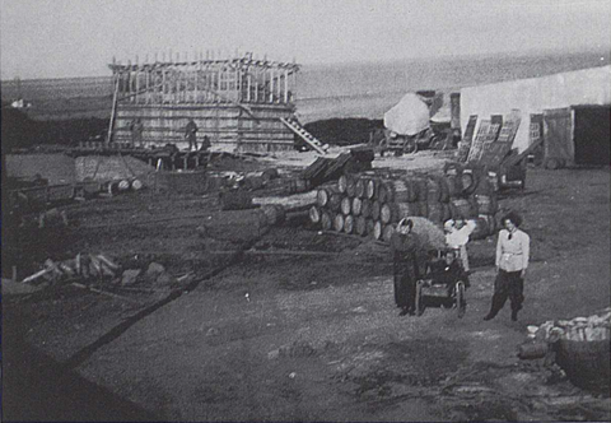
From an article by Karvel Ögmundsson in Faxi. Construction work on the Freezing Plant Pier, which forms the foundation of the present Suðurgarður (South Breakwater) at Njarðvík Harbour.
Rapid Growth in the Years That Followed
In the years that followed, there was significant growth in the development of harbour infrastructure in Ytri-Njarðvík. In the summer of 1949, the harbour breakwater was extended by 26 metres and the protective breakwater at Klapparnef by 30 metres; in addition, a 44 metre shelter wall was cast on the harbour breakwater. Furthermore, the Höskuldarkot pier was raised to full height and a deck cast over it. The harbour breakwater was again extended by 12.3 metres in 1951 and by a further 11 metres the following year. In 1955, the boat pier, or Ársælsbryggja—named after the fishing vessel Ársæll—was slightly repaired. The protective breakwater at Klapparnef was extended once more by 12 metres in 1957. The following year, improvements were made to the boat slipway in Ytri-Njarðvík, but harbour construction came to a halt in 1957, and this pause lasted for six years.
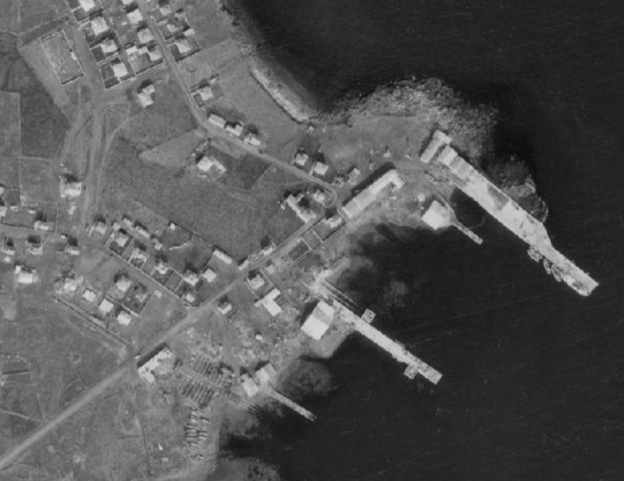
Image from the Reykjanesbær map viewer from 1954 showing the location of the four piers that were built at the harbour in Ytri-Njarðvík. Höskuldarkot pier forms the foundation of the North Breakwater and the Freezing Plant Pier/Karvelsbryggja forms the foundation of the South Breakwater. Both Ársælsbryggja and Bragabryggja have been covered by land reclamation.
At this point, Bragabryggja, a wooden pier used by small boat owners and providing shelter for the Njarðvík Shipyard, had become very dilapidated, and there were concerns that it would not withstand the strain if larger vessels would dock. The leaders of the Njarðvík Shipyard emphasised the need to improve the pier. The Ministry of Transport granted permission for this, and the board of the National Harbour was tasked with securing funds for the work. Magnús Konráðsson, an engineer at the Lighthouse and Harbour Authority, prepared plans for a 55‑metre-long protective breakwater by the slipway. The Njarðvík Shipyard undertook its construction, and the work was completed in the autumn of 1958. All further development at the harbour in Ytri-Njarðvík was then halted for several years, despite the need for improvements. Bragabryggja has long since been absorbed into the operational area of the Njarðvík Shipyard. It may be noted that the building of the former Njarðvík Machine Workshop (Vélsmiðja Njarvíkur) once stood at the end of the pier.
In 1959, the board of the National Harbour prepared a six‑year plan for the construction of harbour facilities under its management. The plan assumed that the harbour at Ytri-Njarðvík would be capable of serving three cargo vessels simultaneously, 25 fishing vessels of up to 150 tons, and that berthing space would be created for up to 150 fishing vessels, each between 75 and 150 tons. Magnús carried out an assessment of the harbour structures in Ytri-Njarðvík and proposed that the harbour breakwater be extended by 50 metres and widened by 2 metres, from 10 to 12 metres. In addition, Ársælsbryggja was to be extended by 95 metres. Funding for the project, however, was not obtained. Ársælsbryggja has since been covered by land reclamation.
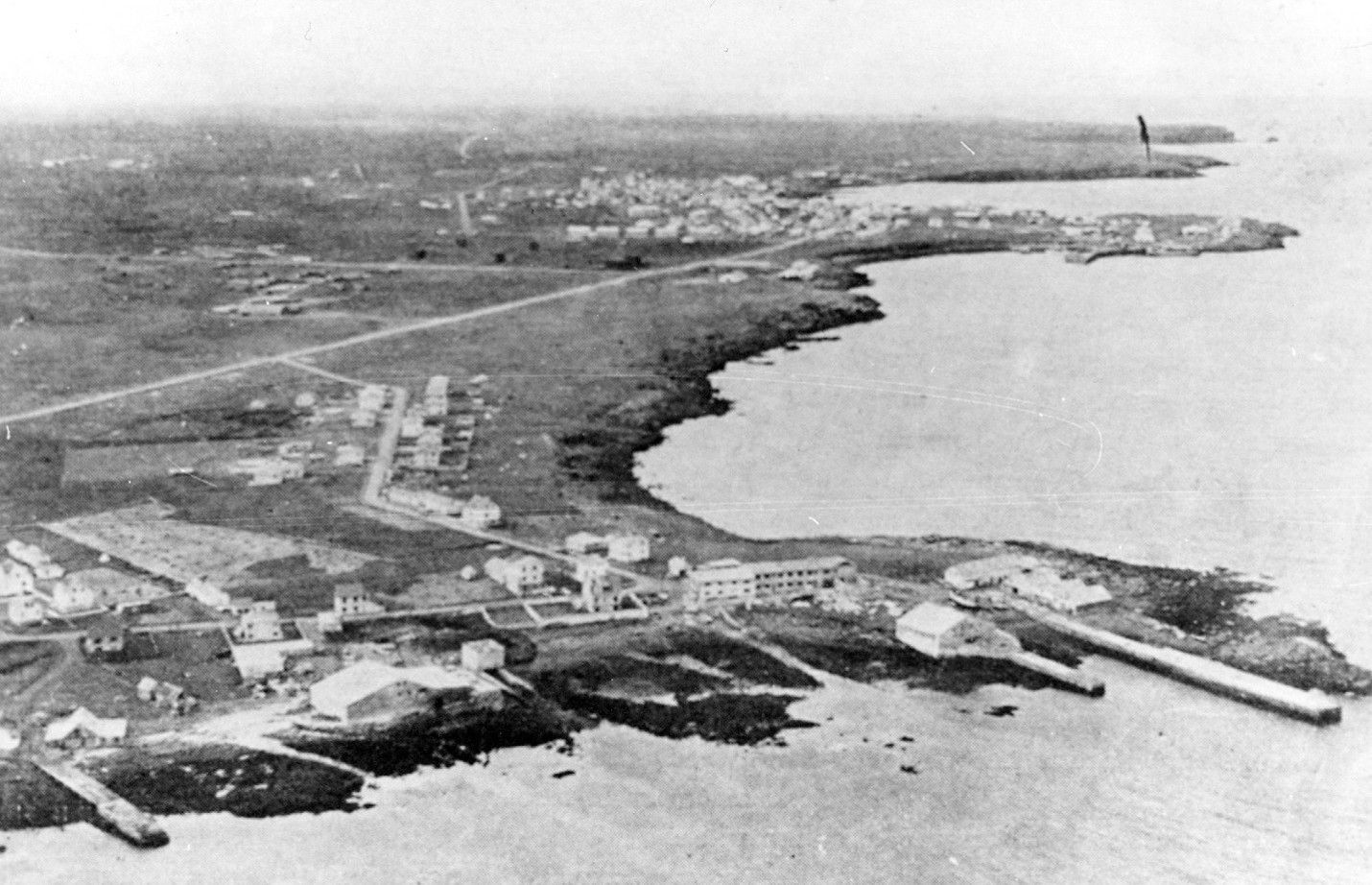
Overview image of Njarðvík Harbour before the expansion of the present South Breakwater. Photograph from the Reykjanesbær Heritage Museum, photographer unknown.
Keflavík and Njarðvík Residents Press for Improvements to the National Harbour
Fishing operators in Keflavík and Njarðvík had grown increasingly frustrated with the lack of facilities, and in September 1962 the municipal council of Keflavík, the parish council of Njarðvík, and the board of the National Harbour held a joint meeting at which, among other things, dissatisfaction with the authorities’ performance in harbour matters was discussed. Those present were urged to press the members of parliament for the constituency to secure funding for improvements to the National Harbour. At another meeting on harbour matters, a resolution was adopted expressing support for the development plan of the National Harbour board from 1959.
It is considered that the unity of the people of Keflavík and Njarðvík led to their campaign for improvements to the National Harbour being successful. Funding was obtained for the extension of the harbour breakwaters in Ytri-Njarðvík, the North and South Breakwaters, and construction began in 1963. Following a tender process, Efrafall sf. was awarded the contract for the work, which lasted for nearly seven years. The outer breakwater, the North Breakwater, was completed first and handed over to the harbour authorities at the end of 1966, while construction of the South Breakwater was completed in early 1970. The two breakwaters are T shaped, and for the first time hollow blocks filled with concrete were used in breakwater construction; until then, cast concrete units had predominated in harbour construction in Iceland.
In 1975, an additional rock protection breakwater was constructed on the North Breakwater, and the operational area was expanded, after a severe storm that struck the country in January of that same year which damaged the existing structure. This work was completed in 1978 and significantly improved landing facilities at the harbour. The rock used for the protective breakwater was taken from a quarry at the northern end of Keflavík.
In 1981, work began on dredging at the outer head of the North Breakwater. At the same time, 45 metres of steel sheet piling were installed to extend the berthing edge along the outside of the breakwater. This created a berthing edge with a depth of 7.5 to 9 metres for vessels up to 130 metres in length. In addition, a 7,000 square metre container area was paved, which was, among other uses, utilized for transport operations of the Defence Force through the harbour at that time. The work was completed in 1982, and as a result the service capacity of Njarðvík Harbour for larger vessels increased.
Municipal Authorities Take Over the National Harbour
A turning point occurred at the turn of the year 1989/1990, when the Minister of Transport and the Minister of Finance, on behalf of the state, transferred ownership of the Keflavík–Njarðvík National Harbour to the municipal councils of Keflavík and Njarðvík. At the same time, the harbour’s name was changed to Keflavík–Njarðvík Harbour. Upon the transfer, funding was secured for maintenance and construction, and commitments were made for financial allocations in the coming years.
Following this, plans were initiated for the construction of a connecting road between the harbour areas in Keflavík and Njarðvík, the so-called Bakkavegur. It was made passable for traffic in 1991 and represented a major improvement in transport conditions for the fishing industry. Subsequently, plans were made to examine the possibility of constructing a small-boat harbour in Gróf, capable of accommodating up to 50 small boats. Construction of the small-boat harbour began toward the end of 1991 and was completed in 1995. The harbour was, however, officially inaugurated on 27 November 1992.
Around the turn of the year 1991/1992, the Suðurnes Fish Market was relocated to Hafnarbakki 13 at Njarðvík Harbour. Along with the relocation of the fish market, a landing crane was installed on the North Breakwater. Work also began on land reclamation between the breakwaters, creating a good working area and easy access for transporting fish to the fish market building. The market operated at Njarðvík Harbour until 2009, when the property was sold to Saltver hf.
In 1995, Njarðvík Harbour had an ice tower constructed at the harbour, and the building was leased to Sigurður Hallgrímsson. Sigurður relocated ice-making equipment from Garður and operated an ice plant until 1999, when he sold the operation to Njarðvík Harbour, which has run the ice tower since. This service is based on delivery at the factory gable, where customers can collect the product either in containers or directly on board the relevant fishing vessel.
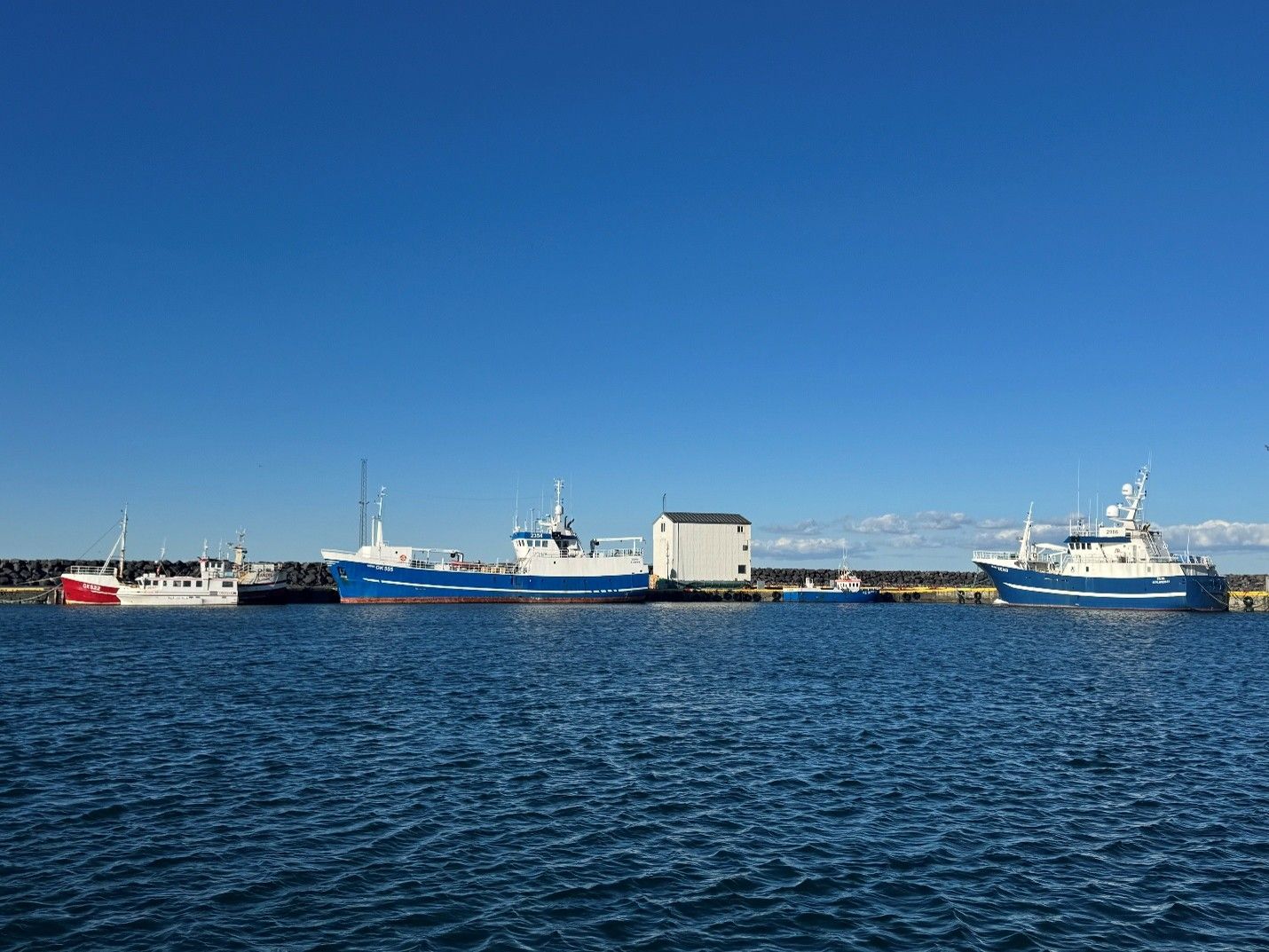
The ice tower on the North Breakwater of the harbour. Photograph by Svanhildur Eiríksdóttir.
The municipalities of Keflavík, Njarðvík, and Hafnir were merged in June 1994, at which point Hafnir Harbour (Hafnahöfn) was added as part of Keflavík–Njarðvík Harbour. The Suðurnes Harbour Association was established at the beginning of 1997 through the merger of Keflavík–Njarðvík Harbour with the harbours in Vatnsleysustrandarhreppur and Gerðahreppur. The association was dissolved at the end of 2002, and Reykjanes Harbour commenced operations in its current form in December of that same year.
Further Development of Njarðvík Harbour and Future Plans
In 2003, work began on extending the rock protection breakwater in Njarðvík Harbour that had originally been constructed in 1978, as it was considered not to provide sufficient shelter. This work was completed in 2004, and the breakwater was extended by 60 metres. This extension significantly improved berthing conditions in the harbour.
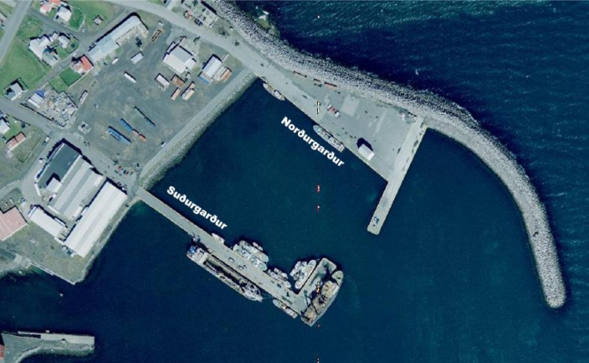
The appearance of the North Breakwater after the extension of the rock protection breakwater was completed in 2004. Image from the Reykjanes Harbour future vision from 2018.
Larger fishing vessels are generally assigned berths in Njarðvík Harbour. The harbour also serves as a short-term berthing facility for fishing vessels that make use of the services of Njarðvík Shipyard. A considerable number of cargo vessels also called at Njarðvík Harbour in earlier years, but traffic has largely shifted to Helguvík Harbour with the development of the industrial area there.
From 2020 onwards, preparations began for the expansion of the harbour area in Njarðvík, including at the operational area of Njarðvík Shipyard on the southern side of the harbour to accommodate future development plans. Development has begun at the harbour area with dredging and the construction of a coastal protection barrier in accordance with these plans.
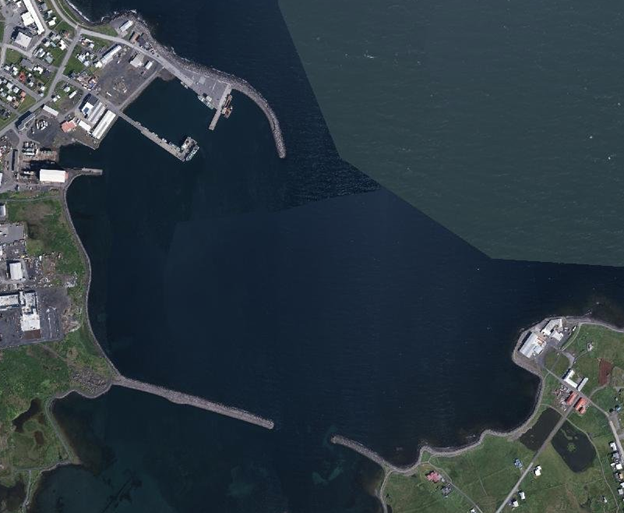
Overview image of Njarðvík Harbour from the Reykjanesbær map viewer showing the appearance of the harbour in 2025.
In 2024, development projects that had been planned for many years began at Njarðvík Harbour. These developments consist of the construction of a sheltering breakwater for the existing harbour structures and dredging within the harbour area. The first phase began in the spring with dredging and was completed in the first half of 2025. At the same time, the second phase—consisting of the construction of the sheltering breakwater—was put out to tender, and that work was completed in the autumn. The third phase of this development consists of the construction of a 200 metre berthing quay within the sheltering breakwater, along with other associated harbour facilities. This phase began in 2026, and the breakwater will provide the harbour with exceptional conditions as a thriving harbour in the future.
Summary: Svanhildur Eiríksdóttir
Harbour Masters of the National Harbour Keflavík–Njarðvík, later Reykjanes Harbour (from 1994)
Þórhallur Vilhjálmsson 1946-1949
Ragnar Björnsson 1950-1979
Ágúst Jóhannesson 1979-1986
Pétur Jóhannsson 1987-2015
Halldór Karl Hermannsson 2015 – present
Sources
• Án höfundar (1992, 1. febrúar). Vertíðarfréttir. Faxi, 52. árg. (2. tbl.), bls. 35.
• Guðfinnur Sigurvinsson (1990, 1. janúar). Landshöfnin Keflavík-Njarðvík. Faxi, 50. árg. (1. tbl), bls. 7
• Halldór Karl Hermannsson (2020, 28. maí). Reykjaneshöfn í fortíð og nútíð. Unpublished Power point show.
• Hallgrímur Th. Björnsson (1967, 1. apríl). Landshöfnin Keflavík-Njarðvík. Faxi, 27. árg. (4. tbl.), bls. 45-46.
• Helgi Hólm (1982, 1. febrúar). Úr flæðarmálinu. Faxi, 42. árg. (2. tbl.), bls. 38.
• Hilmar Bragi Bárðarson (2023, 18. ágúst). Yfirbyggð þurrkví og fyrsta nýsmíði Skipasmíðastöðvar Njarðvíkur í áratug. https://www.vf.is/vidskipti/yfirbyggd-thurrkvi-og-fyrsta-nysmidi-skipasmidastodvar-njardvikur-i-aratugi
• Kristján A. Jónsson (1991, 1. júní). Við vertíðarlok. Faxi, 51. árg. (4. tbl.), bls. 111.
• Kristján Sveinsson (1996). Saga Njarðvíkur. Þjóðsaga ehf.
• Reykjanes Port Board and Harbour Master (2018). Reykjaneshöfn: Framtíðarsýn komandi 10 ára (unpublished report).
• www.reykjaneshofn.is
Images
• Byggðasafn Reykjanesbæjar. Photos from the local history museum's collection; HeimirP-905 and Safnið 112072. Photographers unknown.
• Karvel Ögmundsson (1992, 1. september). Njarðvík. Faxi, 52. árg. (5. tbl.), bls. 148.
• Kirk, N.P. og Thorvald Krabbe (1922). Survey of Harbours on the Icelandi Coast í Tímarit Verkfræðingafélags Íslands 7. árg, 2. tbl. bls. 45
• Kortasjá Reykjanesbæjar. https://www.map.is/reykjanesbaer/
• Kristján Sveinsson (1996). Saga Njarðvíkur. Þjóðsaga ehf.
• Reykjanes Port Board and Harbour Master (2018). Reykjaneshöfn: Framtíðarsýn komandi 10 ára (unpublished report).
• Svanhildur Eiríksdóttir. Photo of Ice tower, taken in May 2026.